
ニルヴァーナの智慧を求めて
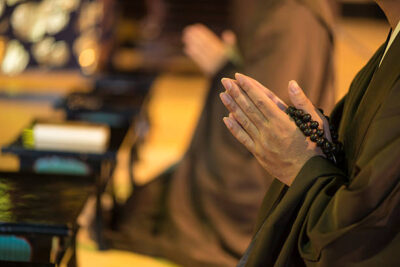
In front view, close up of monk’s hands in prayer with a rosary. Visible just hands. In background blurred image of other monk kneeling in prayer. Chion-ji temple in Kyoto, Japan
風は静かに山の稜線をなぞっていた。谷間にたたずむ古寺、その奥深く――時を越えて閉ざされていた石室の扉が、重々しく開かれた。
中に入ったのは、若き修行僧アーナンダ。彼は、自らの無明を破るため、長い旅を続けてきた者だった。老僧バラモンが、古い巻物を手渡しながら、低く語りかける。
「この経は、世に忘れられし修行の法。ブッダご自身がさとりの階梯として歩まれた、真の道である。」
アーナンダの目が光る。
「それは……大乗の教えとは異なるのですか?」
老僧はうなずいた。
「多くの者が大乗の華やかな説法に心を奪われている。しかし、ブッダの足跡を、最も明確に映しているのは、原始の教典、阿含の経にこそあるのだ。そこに、悟りへ至る七つの法門、三十七の修行項目――すなわち『七科三十七道品』が説かれている。」
「七科……三十七道品?」
老僧は巻物をひらき、ゆっくりと唱える。
「四念住、四正断、四神足、五根、五力、七覚支、八正道……これが七科である。それぞれが、悟りに至るための階梯となり、三十七の具体的な実践項目となる。」
アーナンダは目を閉じた。耳に残るのは、老僧の静かな声。
「この法は、パーリ語の中阿含、キンティ・スッタに明確に記されておる。ブッダが比丘たちに語られたのだ。『我が説く法は、真に悟られしものである。四念住より始まり、八正道に至るこれらを学ばずして、汝らはニルヴァーナを得ることはできぬ』と。」
老僧は、巻物をアーナンダの手に握らせた。
「おまえが求めるのは、神聖なる智慧であろう? ならば、これがそのカリキュラム。七つのシステムにして、三十七の訓練法。心の深奥へと降りてゆけ。そうすれば、おのずと真実の光が現れるであろう。」
寺の外では、黎明の風が雲を払いはじめていた。
アーナンダは、巻物を胸に抱きしめながら、静かに誓った。
「必ずや、この智慧の道を歩みぬく。ニルヴァーナの光が、我が心を照らすその日まで。」
第二章 受念住 ― 揺れる心、たゆたう感覚
それは、ある雨の日のことであった。
小屋の屋根を打つ雨音が、単調に続いていた。外界とのすべての関係が断たれ、アーナンダは己の心とだけ向き合う静寂にあった。
彼は坐を組み、そっと目を閉じる。
「次に観ずべきは、受である」と、師バラモンは語っていた。
「受とは、感受である。喜び、苦しみ、快・不快、無関心――それらは心に生じては消える波。だが、愚者はそれを“わがもの”と思い、掴み、流される。賢者はそれを“ただの感受”と見て、手放す」
アーナンダは、その言葉を思い出しながら、心の中を見つめる。しばらく何も感じないように思えた。だが、そこに注意を集中すると、確かにあった。
――物悲しさ。
――孤独。
――そして、小さな焦り。
(ああ、わたしの中には、苦の“受”がある……)
彼は、その苦を否定せず、ただ見つめた。まるでそれが誰か他人の苦しみであるかのように。
やがて、その苦は、静かに姿を変えていった。悲しみの底にあったのは、愛だった。師への思慕、仲間への想い。だがその想いが叶わぬとき、人は苦を生じる。
「なるほど……」
次に、彼の心に過去の記憶がよぎった。師の言葉に褒められたあの日、胸が熱くなったあの瞬間。
(これが、楽の“受”)
楽しさもまた、ただの感覚。永遠には続かず、変わりゆくもの。
そして今――雨音だけが響く静寂の中で、彼の心は不思議な「中立」の感覚に包まれていた。苦しくもなく、楽しくもない。ただ、静かにそこにある。
(これが、捨受。すなわち「無記の受」……)
アーナンダの呼吸は深くなっていく。感覚が、波のように生まれては消えていくのを、ただ見守っている。
そこに、永遠なるものはなかった。
苦も楽も、「わたし」のものである必要はなかった。
それらは、ただ生じて、ただ滅する。
それが真実なのだ。
アーナンダはそっと目を開いた。雨は、いつのまにか止んでいた。雲間から一筋の光が差し込み、土の匂いが、清らかな風に混じって流れてきた。
彼はその光と香りを、ただ受け取った。歓喜もなく、拒絶もなく。
――これが、受念住。
心に生じるあらゆる感覚を、ただの“波”として見る。その深奥に、智慧の芽がひそかに宿りはじめていた。
第三章 心念住 ― 心のかたちを映す鏡
月が昇るころ、山の庵には、静寂が降りていた。アーナンダは、薄衣を肩に掛け、今夜もひとり、坐に入った。
「身を観じ、受を観じて、最後に残るもの。それが“心”である」と、師は語った。
「心念住とは、今この瞬間、いかなる心があるかを知ること。貪りがあるか、怒りがあるか、迷いがあるか。あるいは、それが去ったのか。それを知り、見抜き、離れていくこと」
アーナンダは、呼吸とともに心を澄ませていく。すると、突如――
ひとつの記憶が浮かび上がった。
それは、かつて仲間の修行僧と些細な言い合いをした日のこと。相手の言葉が、どうしても許せなかった。彼の中に、怒りがふつふつと沸いた。
そして今、瞑想の中でもなお、その怒りの「残り香」が微かに蘇ってくるのを感じた。
(怒り……)
彼は、その心を見つめた。
怒りとは、火のようなものだ。心を焼き、理を失わせる。だがその火も、ただ心に生じた一つの現象にすぎない。真実の“我”ではない。
アーナンダはさらに心を沈めた。
すると今度は、静かな慈しみが湧き上がってくる。あのとき、自分もまた苦しかった。相手もまた迷いの只中にいた。――それを赦す心。
(これも、また心)
欲する心、怒る心、信じる心、疑う心――どれもが、現れては消える。流れる雲のように。
それを「私」と呼ぶなら、「私」は刻々と形を変え、定まることがない。
(では、“私”とは何なのか?)
アーナンダは、その問いを胸に置いたまま、ただ心を観じ続けた。
今、この瞬間、自分の心は穏やかか、動揺しているか。眠気はあるか、喜びはあるか。ありのままに、それを映し出す“心の鏡”を、自らの内に据える。
すると彼の内なる空間に、透明な静けさが生まれた。
心とは、無限の姿を取りながら、空に浮かぶ雲のように、来ては去り、現れては消える。
それを知ったとき、アーナンダの中に、柔らかな微笑が芽生えた。
もはや、怒りや欲に巻き込まれる必要はなかった。
なぜなら――彼は、それらが「ただの心の状態」であると、知ったからだ。
第四章 法念住 ― 真理に目覚めるまなざし
森の夜は、深く、静かであった。
アーナンダは、灯明も持たずに、木の根元に坐った。目を閉じ、ただ己の呼吸と共にある。
この夜、彼は、ある問いを胸にしていた。
(苦しみの根は、どこにあるのか?)
思い返せば、さまざまな「感情」「思考」「記憶」が、彼を悩ませてきた。だが、それらは単なる現象ではなかったか? なぜ、人は現象に巻き込まれ、迷い、煩悩にとらわれるのか?
その答えを、師はこう語っていた。
> 「アーナンダよ、汝は“法”を観ずして、ただ感情に揺れるばかりではないか。心に生じるもの、すべては“因と縁”によって生じる。
> それを見よ――すなわち“十二因縁”の観察である。
> 無明あれば、行あり。行あれば、識あり。識より名色、六処、触、受、愛、取、有、生、老死……」
アーナンダは、師の言葉を胸に、その因縁の連鎖を観ていった。
――無明。
(知らぬこと、気づかぬこと。真理を見ないまま生きること)
――行。
(無明から出た衝動、業の積み重ね)
――識。
(意識が生まれ、世界と自我が目覚める)
……と連鎖は続き、やがて「老い」「死」へと至る。
(このすべてが、苦の流れ。だが、その根源は、“無明”にあったのか……)
アーナンダの心は、少しずつ沈み込んでいった。
彼はまた、五蘊にも思いを馳せた。
色・受・想・行・識――すなわち、肉体、感覚、認識、意思、意識。
(これが「わたし」だと思ってきたものは、すべて集まりでしかなかった……)
彼は、自らの心身を、「自己」としてではなく、「法」として見始めた。
喜びも、怒りも、肉体の疲労も、思い出も――すべては因縁によって一時的に現れた、無常の現象であった。
それらを掴んで「これは私」と思うことが、苦のはじまりだったのだ。
彼の心は、深い沈黙のなかで、透き通っていった。
――すべてのものは、縁により生じ、縁により滅す。
――それが、「法(ダンマ)」である。
アーナンダは、静かに息を吐いた。
彼の内なる目は、ついに「真理の流れ」を見つめはじめたのだった。
煩悩は、ただ現れては消える泡。
「我」は、それに名前を与えていたに過ぎない。
――これが、法念住。
四念住の最後にして、智慧の扉が開く一歩手前の、最も深い観照。
夜が明け、東の空が白みはじめていた。
アーナンダのまなざしには、もはや揺らぎがなかった。
In search of the wisdom of Nirvana
The wind quietly traced the mountain ridge. Deep inside an old temple nestled in a valley, the door to a stone chamber that had been closed for ages slid open with a heavy sound.
The young monk Ananda entered. He had been on a long journey to break free from his own ignorance. The old Brahmin monk spoke softly as he handed him an old scroll.
“This sutra is a method of training forgotten by the world. It is the true path that the Buddha himself walked as a step to enlightenment.”
Ananda’s eyes lit up.
“Is that… different from the teachings of Mahayana?”
The old monk nodded.
“Many are fascinated by the gorgeous teachings of Mahayana. However, it is the original scriptures, the Agama sutras, that most clearly reflect the footsteps of the Buddha. There, the seven methods and thirty-seven training items leading to enlightenment are explained – in other words, the ‘Seven Subjects and Thirty-seven Paths.'”
“Seven Subjects… Thirty-seven Paths?”
The old monk opens the scroll and slowly recites.
“The Four Mindfulness, the Four Right Decisions, the Four Divine Feet, the Five Roots, the Five Strengths, the Seven Enlightenments, the Eightfold Path… These are the seven subjects. Each of these is a step to enlightenment, and is one of the thirty-seven concrete practical items.”
Ananda closed his eyes. The quiet voice of the old monk remained in his ears. “This law is clearly written in the Pali Middle Agama, Kinti Sutta. The Buddha spoke to the monks: ‘The law I preach is the truly realized one. You cannot attain Nirvana unless you study these, beginning with the Four Mindfulnesses and concluding with the Eightfold Path.'”
The old monk placed the scroll in Ananda’s hand.
“Is it divine wisdom you seek? Then this is the curriculum. Seven systems, thirty-seven training methods. Descend into the depths of your mind. Then the light of truth will appear of its own accord.”
Outside the temple, the dawn wind was beginning to clear the clouds.
Ananda held the scroll close to his chest and silently vowed.
“I will walk this path of wisdom to the end. Until the day the light of Nirvana shines upon my heart.”
Chapter 2: Mindfulness of Feeling – A Wavering Heart, a Floating Sense
It was a rainy day.
The sound of rain hitting the roof of the hut continued monotonously. All ties with the outside world were cut off, and Ananda found himself in silence, facing only his own heart.
He sat cross-legged and gently closed his eyes.
“The next thing to observe is feeling,” his teacher, the Brahmin, had said.
“Feeding is perception. Joy, pain, pleasure, discomfort, indifference — these are waves that arise and disappear in the mind. However, fools think of them as ‘mine,’ grab hold of them, and are swept away. A wise man sees them as ‘just perception,’ and lets them go.”
Ananda remembered those words and looked into his heart. For a while it seemed like he felt nothing. But when he focused his attention there, it was certainly there.
–Sadness.
–Loneliness.
–And a small sense of impatience.
(Ah, inside me there is the “receiving” of suffering…)
He didn’t deny the suffering, he just stared at it. As if it was someone else’s suffering.
In time, the suffering quietly changed its form. At the bottom of the sadness was love. Yearning for the teacher, feelings for friends. But when those feelings are not fulfilled, people suffer.
“I see…”
Then a memory from the past came to his mind. The day his teacher praised him, the moment his heart warmed.
(This is the “receiving” of pleasure)
Pleasure is also just a feeling. It doesn’t last forever, it changes.
And now–in the silence where only the sound of rain echoes, his heart was enveloped in a strange feeling of “neutrality.” It was neither painful nor enjoyable. It was just there, quietly.
(This is renunciation. In other words, “unawareness of mind”…)
Ananda’s breathing deepens. He simply watches as sensations arise and disappear like waves.
There was nothing eternal there.
Pain and pleasure did not have to belong to “me.”
They simply arise and simply disappear.
That is the truth.
Ananda gently opened his eyes. The rain had stopped at some point. A ray of light shone through the clouds, and the smell of the earth mixed with the pure breeze flowed in.
He simply accepted the light and the scent. Without joy, without rejection.
–This is mindfulness of mindfulness.
He sees all sensations that arise in the mind as mere “waves.” Deep within, the seeds of wisdom began to quietly dwell.
Chapter 3 Mindfulness – A mirror that reflects the shape of the mind
As the moon rose, silence descended on the mountain hut. Ananda draped a thin robe over his shoulders and sat alone again tonight.
“Observe the body, observe the feeling, and what remains in the end is the ‘mind’,” his teacher said.
“Mindfulness is knowing what kind of mind you have at this very moment. Is there greed, anger, confusion? Or have they gone? Knowing, seeing through, and letting go.”
Ananda cleared his mind as he breathed. Then, suddenly-
a memory surfaced.
It was a day when he had a trivial argument with a fellow monk. He could not forgive the words of the other person. Anger bubbled up inside him.
And now, even in meditation, he felt a faint “lingering scent” of that anger faintly returning to him.
(Anger…)
He stared at his heart.
Anger is like fire. It burns the heart and makes one lose reason. But that fire is merely a phenomenon that arises in the heart. It is not the true “self.”
Ananda calmed his heart even further.
Then, a quiet compassion welled up inside him. At that time, he too had suffered. The other person was also in the midst of confusion. –A heart that forgives them.
(This is also the heart)
The heart that desires, the heart that is angry, the heart that believes, the heart that doubts — each of these appears and disappears. Like passing clouds.
If we call that “I,” then the “I” changes shape from moment to moment and is never fixed.
(So what is “I”?)
Ananda kept this question in his mind and continued to observe his heart.
Right now, at this moment, is his heart calm or agitated? Is he sleepy or happy? He placed within himself the “mirror of the mind” that reflected it as it is.
Then, a clear silence was born in his inner space.
The mind, like a cloud floating in the sky, comes and goes, appears and disappears, while taking infinite forms.
When he realized this, a soft smile sprouted within Ananda.
There was no need to get caught up in anger or desire anymore.
Because he knew that they were “just states of mind.”
Chapter 4: Mindfulness of the Dharma – A Gaze that Awakens to the Truth
The night in the forest was deep and quiet.
Ananda sat at the base of a tree without a lamp. He closed his eyes and was simply with his own breathing.
That night, he had a question in his mind.
(Where is the root of suffering?)
Thinking back, he had been troubled by various “emotions,” “thoughts,” and “memories.” But weren’t these simply phenomena? Why do people get caught up in phenomena, become lost, and become trapped by worldly desires?
His teacher gave the answer:
> “Ananda, you are not observing the ‘dharma,’ and are merely swayed by your emotions. Everything that arises in the mind arises from ’cause and condition.’
Look at this — that is, observe the ‘twelve dependent links.’
> Where there is ignorance, there is action. Where there is action, there is consciousness. From consciousness there is name and form, the six sense organs, touch, feeling, appreciating, grasping, being, birth, old age, and death…”
Ananda took his teacher’s words to heart and observed the chain of causes and conditions.
–Ignorance.
(Not knowing, not realizing. Living without seeing the truth)
–Action.
(Impulse born of ignorance, accumulation of karma)
–Consciousness.
(Consciousness is born, and the world and the ego awaken.)
… and so the chain continues, eventually leading to “old age” and “death.”
(All of this is a flow of suffering. But perhaps its root lies in “ignorance”…)
Ananda’s mind slowly sank.
He also reflected on the five aggregates.
Form, feeling, perception, volition, and consciousness – that is, the body, senses, perception, will, and consciousness.
(Everything he had thought of as “I” was nothing more than a collection…)
He began to see his own mind and body not as “self” but as “dharma.”
Joy, anger, physical fatigue, memories – all were impermanent phenomena that appeared temporarily due to causation.
Grasping these things and thinking “this is me” was the beginning of suffering.
In the deep silence, his mind became clear.
– Everything arises from causation and perishes from causation. –That is Dhamma.
Ananda let out a quiet breath.
His inner eyes had finally begun to gaze upon the “stream of truth.”
Worldly desires are merely bubbles that appear and disappear.
The “self” has merely given them a name.
–This is Dhamma mindfulness.
The last of the four mindfulness practices, the deepest contemplation, one step before the door to wisdom opens.
Dawn broke, and the eastern sky was beginning to lighten.
Ananda’s gaze no longer wavered.