
集中(止)と瞑想(観)
瞑想の修行は、主に二つの領域から成り立っています。
- 精神集中法(concentration)
精神集中法は、心を集中させることを目的とした修行です。この修行は、思考や感情が乱れている場合に役立ちます。精神集中法の具体的な方法には、呼吸法やマントラ(特定の言葉やフレーズの繰り返し)を用いる方法があります。これらの方法を使って、思考や感情を受け流し、心を静めることができます。
- 瞑想(meditation)
瞑想は、精神集中法を通じて心を静めた状態から始まります。瞑想の目的は、内面の真理や平穏を探求することです。瞑想の具体的な方法は、様々なものがありますが、一般的には心を開放し、自分自身や周りの世界とのつながりを深めることを目的とします。瞑想は、心身の健康に良い影響を与えるとされ、ストレスや不安を軽減する効果があるとされています。
以上のように、精神集中法と瞑想は密接に関連しており、心を静め、自己探求や内面の平穏を得るための修行として行われます。
Meditation practice consists of two main areas: concentration and meditation.
- Concentration
Concentration is a practice that aims to focus the mind. This practice is useful when thoughts and emotions are scattered. Specific methods of concentration include breathing exercises and the repetition of a mantra (a specific word or phrase). These methods can be used to let go of thoughts and emotions and calm the mind.
- Meditation
Meditation begins with a calm mind achieved through concentration. The purpose of meditation is to explore inner truth and tranquility. There are many different methods of meditation, but generally the goal is to open the mind and deepen the connection with oneself and the world around us. Meditation is believed to have positive effects on both mental and physical health, reducing stress and anxiety.
In summary, concentration and meditation are closely related practices that are used to calm the mind, explore oneself, and find inner peace.
では瞑想に入ろう。
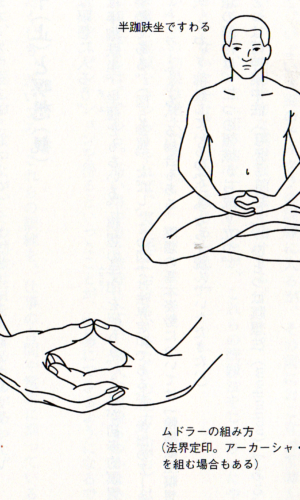
坐は半珈鉄坐。坐蒲をもちいる。瞑想の手印を組もう。これが初歩的瞑想の基本姿勢である。(図5参照。ただし、この図では法界定印であるが、後出のアーカーシャームドラーをもちいる場合もある。
瞑想の修行は、二つの領域から成り立つ。
ひとつは精神集中法、ひとつは瞑想である。
心を集中するとは。まず、シャマタ(止)である。、禅における公案、また、祈りを捧げるとか、経を読む、真言を唱えるなども、精神集中法のひとつである。要はひとつのことに心を集中し、そこに〃止”まり、動かないことである。
これは、ひとっのことに心を集中するのである。
数息観がそ‘の代表であるが、、とで’‐ ことてことに意識を集申し、他のものに心を向けない、これを積極的に意識的におこなうのであるひこれは修行のはじめの過程として、だれでも通るものである。
この精神集中の状態は二つに分けることができる。ひとつはこ息識的精神集中」で、ひとつのことに
つぎの段階が、「無意識的精神集中しの状態である。これは、高度のもので、意識的精神集中をつづけているうちに、習練によって条件づけられ、ついに、とくに意識しないでもひとつのことに心を集中することができるようになる。
これによって無意識の意識層をコットロ’ーうでは絶対に統御できない無意識の意識を、ある特定の対象に向けることができるようになるのである。
心の流れにまかせるとは
つぎに、ビパシャナ(観)である。
これは、ひとつのことに注意をとどめない。心の動きのひとつひとつに心を向けていくが、ひとつのことにとどまっていない。心の流れにまかせるのであ
る。
これにも、「意識的瞑想」と「無意識的瞑想」がある。
「意識的瞑想」は、表面意識が心の流れを観ている。
「無意識的瞑想」は、深層意識の心の流れそのものになっている。
では、その深層意識の流れを観ているものはなにか? だれが深層意識の流れを観ているのか? それは「無意識的精神集中」の心である。
だから、「止」と「観」は密接な関係があるのである。いまおこなわれている瞑想のほとんどは、「止」か「観」か、どちらかにかたよっている。禅は「止」にウェイトがかかり、瞑想(としてやっているもの)は、「観」が主である。しか
し、「止」を完成した「観」でなければほんとうの瞑想ではなく、「止」でとど
まって「観」に入らない定は、これまたほんとうの瞑想ではないのである。
「止」と「観」はおなじように修せられなければならない。そうして、非常に
高度の瞑想(観)をするためには、おなじように非常に高度の巣中(止)が体得されていなければ不可能なのである。
では「意識的瞑想」と「無意識的瞑想」とはどうちがうのか?
ひと口でいうならば、
意識的瞑想は「個の世界」を観、
無意識的瞑想は「全の世界」を観る。 ・
といったらよいであろう。
意識的瞑想は「自分だけの世界の流れ」を観るのである。
無意識的瞑想は「人類そのものの(世界の)流れ」を観るのである。いや、
もっと拡大した世界だ。「宇宙そのものの流れを観る」といったらよいであろう。
無意識の意識層には、原初からの人類の記憶がすべておさめられている。いや、人類以前からの記憶がすべて秘められている。
Concentration (stop) and meditation (view)
Let’s get into meditation.
The seat is a half-iron seat. Use zafu. Make a meditation sign. This is the basic posture of rudimentary meditation. (See Fig. 5. However, in this figure, although it is a legal seal, the Aker Sharmdler described later may be used.
Meditation practice consists of two areas.
One is mental concentration and one is meditation.
To concentrate on your mind. First is Shamata (stop). , Koan in Zen, praying, reading sutras, chanting mantras, etc. are also one of the methods of concentration. The point is to focus on one thing, stay there, and not move.
This focuses on one thing.
The view of numbers is the representative of that, but in and out, it attracts attention to things, does not pay attention to other things, and actively and consciously does this. As the first process of, anyone goes through.
This state of concentration can be divided into two. One is “concentration of breath and mind”, and one thing
The next stage is “a state of unconscious mental concentration. This is a high degree, conditioned by practice while continuing conscious mental concentration, and finally one thing without being particularly conscious. You will be able to concentrate on.
This makes it possible to direct the unconscious consciousness, which cannot be controlled by the unconscious consciousness layer, to a specific object.
To leave it to the flow of the mind
Next is Bipashana (view).
This does not pay attention to one thing. I focus on each and every movement of my mind, but it’s not just one thing. Leave it to the flow of your heart
To.
There are also “conscious meditation” and “unconscious meditation”.
In “conscious meditation”, surface consciousness is watching the flow of the mind.
“Unconscious meditation” is the flow of the mind of deep consciousness.
Then, what is watching the flow of deep consciousness? Who is watching the stream of deep consciousness? It is the mind of “unconscious concentration”.
Therefore, “stop” and “view” are closely related. Most of the meditations that are being practiced now depend on either “stop” or “view.” In Zen, “stop” is weighted, and in meditation (what is done as), “view” is the main. Deer
However, if it is not a “view” that completes the “stop”, it is not a true meditation, but a “stop”.
The fact that it doesn’t fit into the “view” is not really meditation either.
“Stop” and “view” must be mastered in the same way. And very
In order to perform advanced meditation (viewing), it is impossible unless you have mastered a very high level of nesting (stopping).
Then, what is the difference between “conscious meditation” and “unconscious meditation”?
In a nutshell,
Conscious meditation sees the “individual world”,
Unconscious meditation sees the “whole world”.・ ・
It would be nice to say.
Conscious meditation sees “the flow of your own world”.
Unconscious meditation sees the “flow of mankind itself (in the world)”. Disagreeable,
It’s a more expanded world. It would be nice to say, “Watch the flow of the universe itself.”
The unconscious conscious layer contains all the memories of humankind from the beginning. No, all the memories from before humanity are hidden.