Bonji 梵字 大黒天 Daikokuten マハーカーラMahākāla
大黒天
大黒天(摩利支天と同一種子)
梵名をマハーカーラといい、「大いなる暗黒」との意味があります。
わが国では七福神の一つに数えられ、頭巾をかぶり、大きな袋を背負い、右手に打出の小槌を待った姿で親しまれています。
しかし、本来は、シヴア神の化身とされ、戦闘をつかさどるほか、冥府の神ともされています。
仏教では施福の神として寺院の台所にまつられ、僧侶たちが食べ物の心配をしないで修行に励かことができるように、必要なものが手にはいるように寺院を守護します。
大黒天を食厨の柱にまつったところから、家をささえる最も太い柱や一家のあるじを「大黒柱」というようになりました。一般には福徳の神として、商売繁昌などを祈念します
おん ま ら か きや や そわ か
Daikokuten
Daikokuten (same seed as Marishiten)
His Sanskrit name is Mahakala, which means “great darkness”.
In Japan, it is counted as one of the Seven Lucky Gods, and is familiar with the appearance of wearing a hood, carrying a large bag, and holding a mallet in its right hand.
However, he was originally an incarnation of the god Shiva, and in addition to being in charge of battle, he was also the god of the underworld.
In Buddhism, it is enshrined in the kitchen of the temple as a god of good fortune, and it protects the temple so that the monks can do their training without worrying about food and that they have the things they need.
Since Daikokuten was enshrined on the pillar of the food kitchen, the thickest pillar that supports the house and the head of the family came to be called the ‘daikokubashira.’ Generally, as a god of good fortune, we pray for business prosperity.
Onmaraka Kiyaya Sowaka


Bonji 梵字 不動明王 Fudo Myoo

不動明王
梵名はアールヤアチャラナータビジャヤラージブヤ』どどといい、正式には聖不動威怒明王と呼びます。
諸仏は、つねにさ圭ざまな手段をとって、わたしたち衆生をさとりの道へ歩ませようとします。
しかし、なかには、やさしさだけの慈悲では心を変えない、強情な衆生もいます。
こうした尋常な方法ではとうてい救済できないかたくなな衆生に対して、大日如来は叱りつけるという慈悲のかたちをとって教え導きます。’』、大日如来は不動明王に変化し、忿怒の相をもってあらわれます。
忿怒は実は慈悲のきわみなのです。
酉年生まれの守り本尊とされています。
Fudo Myoo
His Sanskrit name is Arya Acharanatha Vijayarajivya, and his official name is Holy Fudo Iwudyou Myoo.
The Buddhas always use various means to make us, sentient beings, walk the path of enlightenment.
However, there are some sentient beings who are stubborn and will not change their minds with just kindness and mercy.
Dainichi Nyorai teaches and guides the stubborn sentient beings who cannot be relieved by such ordinary methods in the form of mercy by scolding them. ’”, Dainichi Nyorai transforms into Fudo Myoo and appears with an angry face.
Anger is actually the height of mercy.
He is considered to be a guardian deity born in the year of the rooster.


聖徳太子の活躍
 推古天皇の皇太子となった聖徳太子は、国の政治に仏教の教えをとり入れました。太子は2歳の時にすでに「南無仏」と唱えたとされ、奈良県内には「聖徳太子2歳立像」のある寺がいくつかあります。また、太子は仏教を研究するため世俗と離れた斑鳩の宮に住まわれ、そこから飛鳥まで斜めに直線で結ぶ「太子道(たいしみち)」という当時のハイウェイを愛馬黒駒にまたがり日々通勤したといわれています。その太子は、我が国初の仏教注釈書を三冊書き上げたともいわれています(「三経義疏」)。太子の教えは、「世間は仮であり、ただ仏のみが真である」「諸悪をなさず、諸善を行え」といった、分かりやすい言葉で人々に伝えることに主眼があったようです。この考え方は、仏教の普及に大きな影響を与え、基本的には今日まで受け継がれています。
日本の仏教
- 6世紀の中頃(538年とする説が有力です)、欽明天皇の時に、百済の聖明王が仏像と経典を遣わしました。いわゆる仏教伝来です。受け取った仏像を見て、欽明天皇は「仏の顔キラギラし」と金メッキの仏像に大いに感嘆したとのことです。しかし、国家として、従来の土着の古神道に対し、「今来の神」としての仏教を受容するには紆余曲折がありました。やがて、国を二つに割るほどの争いとなり、排仏をとなえた物部氏を蘇我氏が破ることで仏教を公式にまつることに決定したのです。それによって、飛鳥地方には、飛鳥寺、橘寺、川原寺などが次々と建てられていきました。
和讃 仏舎利尊 Wasan Buddhist sarison 3
「宝生解脱のその力 功徳のほどを伝うべし」
福徳宝 生 の徳と因縁解脱の徳、この二つを仏舎利尊さまはご利 益として、わたくしたちにくださる。それはインドの昔から、数限 りない体験談によって証明されています。ですから「功徳のほどを 伝うべし」とあるのです。
像法の時代から末法の時代へ
ま
「そもそも祀る宝塔は 仏の慈悲のかぎりなく
方便止まずして 末世の衆生救わんと 舎利をとどめ置き給う」
これは、お釈迦さまのご慈悲は実に限りないものであり、涅 槃 に入られたのちもなお、末世の衆生を救うために、この世に仏舎利 をとどめ置かれたのである、という意味です。つまり、仏舎利こそ が仏教の本尊であることを示したものです。ことに末法の世の本尊 は、仏舎利しかありません。
仏舎利の功徳に末法の世界の人間を救う、というのがあります。 昔から仏教では、正法の時代、像法の時代、末法の時代、この三 つがあると説かれております。正法というのは、お釈迦さまのお説 きになった教法が、そのまま、まちがいなく行なわれている時代で す。お釈迦さまがおなくなりになって五百年は、この正法の時代で ある、とされております。
それが過ぎますと、像法の時代です。像というのは、鏡に写る影 像のことですから、そのように真実ではない形ばかりの影像の時代 が、像法の時代です。実物ではないわけです。像法の時代は、お釈 迦さまの教えや法が行なわれているように見えるけれども、その内 容はまったく違ったものというわけです。
わたくしは、いまの世は、像法の時代から末法の時代に入ってき ていると思います。たとえばこれまでの日本の仏教が像法の仏教で したね。仏教といってはいますが、お釈迦さまがお說きになった真 実の仏法・七科三十七道品は影も形もない。またそれが説かれた『阿 含経』は、まったくかえりみられない。そうして、そういうものが 仏教という名前で説かれているのですから、まさに像法です。 この像法の千年が経つと、末法に入ります。末法の時代というのは、もう像法でさえ行なわれない時代ということです。仏舎利尊は、 この末法の世界の人たちを救う本尊なのです。末法時代の人という ものは、仏の教えなど真剣に聞こうとしませんから、とにかく、理 くつ抜きに救いの手に掬い上げてやらなければいけない。ですから まず、信じさえすれば必ずそれだけの力をスト レートにくださる、 という仏舎利尊でなければ末法の世は救われないのです。
現形された法爾無作の仏
「変化法身仏舎利尊 納め祀れる霊祠なり」
“The power of Hosho liberation, the degree of merit should be conveyed.”
The virtue of good fortune and the virtue of liberation from karma, these two are given to us by Buddha Sharison as a blessing. It has been proven by countless testimonials from ancient times in India. That’s why it says, “You should pass on your merits.”
From the age of the image law to the age of the end of the law
devil
“In the first place, the treasure pagoda enshrined is the limitless mercy of the Buddha.
In order to save the lives of people in the last world without stopping, please keep the reliquary.”
This means that Buddha’s mercy is truly limitless, and even after he entered Nirvana, he kept the Buddha’s ashes in this world in order to save sentient beings in the latter age. In other words, it shows that Buddha’s ashes are the principal image of Buddhism. In particular, the Buddha’s reliquary is the only principal object of worship in the world of the Latter Day of Law.
One of the merits of Buddha’s ashes is that they save people in the world of the Latter Day of Law. In Buddhism, it has been preached since ancient times that there are three eras: the age of the true law, the age of the image law, and the age of the final law. The right way is the age when the teachings taught by the Buddha are practiced without a doubt. It is said that the 500 years since Shakyamuni passed away is in this age of the true law.
After that, it will be the age of the Image Law. An image is an image reflected in a mirror, so the age of imagery that is not true and only a form of image is the age of image law. It’s not real. In the age of the image law, it seems that the Buddha’s teachings and laws were being practiced, but the content was completely different.
I believe that the present world is moving from the age of the image law to the age of the end of the law. For example, the Buddhism in Japan up to now is the Buddhism of the image law, and he did it. Although it is called Buddhism, there is no trace of the true Buddhism taught by the Buddha, the Thirty-seven Dharma of Seven Courses. Moreover, the Agon Sutra, in which it is preached, is completely irrelevant. And since this kind of thing is preached under the name of Buddhism, it is truly an image law. After the 1000 years of this Image Dharma, we will enter the end of the Dharma. The Age of the Dharma’s End means that even the Image Dharma will no longer be practiced. Butsusharison is the principal image that saves people in this world of the Latter Law. People in the age of the end of the law don’t listen to the Buddha’s teachings seriously, so anyway, I have to scoop them up in the hands of salvation without reason. Therefore, first of all, if he believes, he will surely give that much power to his rate.
Realized Buddha of Hōni
“The Transforming Dharma Body Buddha Sharison is a shrine to be enshrined”
Bonji 梵字 愛染明王 Aizen Myoo
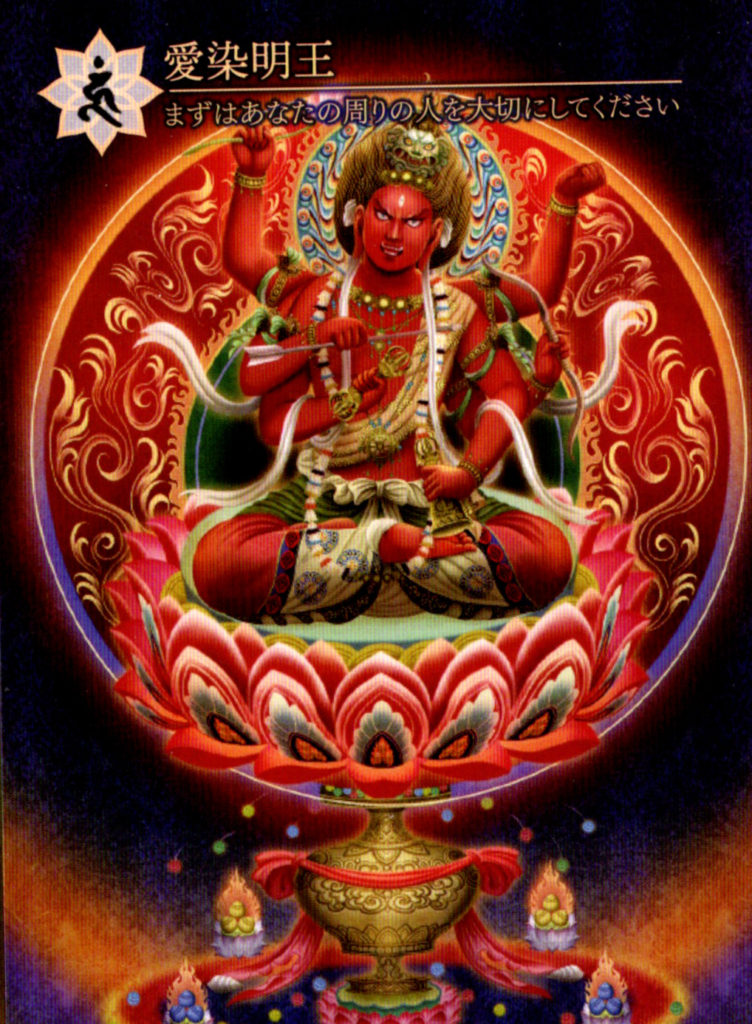
愛染明王
あいぜんみようおう
愛染明王
梵名を、ラーガラーゾヤ(内甜~子)といいます。
ラーガとは「色に染まる」という意味から、貪欲、
かさばり、性欲などをあらわし、「愛染」と漢訳されました。
人を愛するということはすばらしいことです。
ところが、これがゆきすぎますと、溺愛、盲愛といわれる愛のむさばりとなり、人を傷つけてし圭います。これが煩悩です。
しかし、愛というものを、単に恋人や家族だけに向けるのではなく、より多くの人に、人間以外の生きものに、地球全体へと向けたらどうでしょうか。小さな愛は、人類愛、宇宙愛といった犬きな愛情、すなわち菩提心へと発展してゆくことになるでしょう。
のように「煩悩」を「浄菩提心」に昇華させる力を与えてくれるのが愛染明王です.
Aizen Myoo
Aizen Myouou
Aizen Myoo
The Sanskrit name is Ragarazoya (inner sweet child).
Raga means “to be dyed in color” and represents greed, bulkiness, sexual desire, etc., and was translated as “Aizen” in Chinese.
Loving someone is a wonderful thing.
However, if this goes too far, it becomes doting and blind love, which can end up hurting people. This is an annoyance.
But what if we could extend love to more people, to non-human beings, to the whole planet, instead of just to lovers and families? A small love will develop into a dog-like love such as love for humanity and love for the universe, that is, bodhichitta.
will be
Aizen Myo-o gives you the power to sublimate “worldly desires” into “Jyobodaishin.”


和讃 仏舎利尊 Wasan Buddhist sarison 2
要するに、阿含宗こそ仏教の本道を歩んでいる教団である、とお 釈迦さまが自らお認めくださったということにほかならない。これ をみなさんに、まず最初によく認識していただきたいと思います。
礼拝の正しい心がまえ
たた
和讃というのは、日本語でできた、仏さまを讃える歌という意味 です。讃というのは、文字どおり、誉め讃えるということですね。 ふつう仏教で讃という場合、たいてい漢文のものをさしますので、 日本語でできた讃を和讃と呼ぶわけです。キリスト教でいう讃美歌 と思えばよいでしょう。
きみょうちょうらい
「帰命 頂 礼仏舎利尊」
要するに、阿含宗こそ仏教の本道を歩んでいる教団である、とお 釈迦さまが自らお認めくださったということにほかならない。これ をみなさんに、まず最初によく認識していただきたいと思います。
礼拝の正しい心がまえ
たた
和讃というのは、日本語でできた、仏さまを讃える歌という意味 です。讃というのは、文字どおり、誉め讃えるということですね。 ふつう仏教で讃という場合、たいてい漢文のものをさしますので、 日本語でできた讃を和讃と呼ぶわけです。キリスト教でいう讃美歌 と思えばよいでしょう。
「帰命 頂 礼仏舎利尊」
さて、どのような和讃でも、たいてい帰命頂礼ということばでは じまっております。
まず帰命というのは、「南無」の意訳で、命をかけて帰一する、 仏さまに心からお仕えする、という意味です。阿含宗の聖典に「南 無大慈大悲法身駄都如意宝珠尊」とありますが、あの南無です。こ の南無というのはサンスクリット語の「ナマス」をそのまま漢字に 音写したもので、さきほどお話ししたように、仏さまへの深い帰依 をあらわすことばです。 それから頂礼というのは、 頂 に礼するという意味で、五体投地
さて、どのような和讃でも、たいてい帰命頂礼ということばでは じまっております。
まず帰命というのは、「南無」の意訳で、命をかけて帰一する、 仏さまに心からお仕えする、という意味です。阿含宗の聖典に「南 無大慈大悲法身駄都如意宝珠尊」とありますが、あの南無です。こ の南無というのはサンスクリット語の「ナマス」をそのまま漢字に 音写したもので、さきほどお話ししたように、仏さまへの深い帰依 をあらわすことばです。 それから頂礼というのは、 頂 に礼するという意味で、五体投地
のことです。仏教のいちばん丁 重 な、仏さまの拝み方は五体投地 というものですが、これは右足、左足、右手、左手、額の順に五体 を地面につけて、そして自分の額に仏さまのおみ足をいただいてい ると観想して行なう礼のことで、またの名を仏足頂礼といいます。
みなさんが毎日の勤行のときに、 「オン サラバタタギャタ ハンナマンナノウ キャロミ」
と中腰で礼拝するのは略式であって、本来は、五体を地につけて 礼拝しなければいけない。現在は略式になってしまい、少し腰をか がめる程度で礼拝しておりますが、みなさんは五体投地の礼もとき にはきちんとやらなければいけませんね。
いまでも南伝仏教の人たちは、五体投地で礼拝しております。チ ベットなどでも、ラサの周囲何キロというところを、五体投地の礼
せいがん
をしながら三十回あるいは百回まわると誓願を立て、何か月もかけ て巡る修行者を見かけます。
南無、五体投地、仏足頂礼、そういったものをすべて含めて、「帰 命頂礼仏舎利尊」とあらわしているのです。わたくしたちは、仏舎 利尊を生けるお釈迦さまとして礼拝信仰しておりますから、その生 きたお釈迦さまのおみ足を額に受けて礼拝しているのだ、仏舎利尊 さまに命懸けで帰一するのだ、という気持ちで、「帰命頂礼仏舎利 尊」とお唱えしなければいけません。
「宝生解脱のその力 功徳のほどを伝うべし」
In short, it is nothing less than the fact that the Agon sect is the sect that pursues the true path of Buddhism, and that the Buddha himself acknowledged it. I would like everyone to be well aware of this first.
Correct mindset for worship
very much
Wasan means a song written in Japanese to praise the Buddha. Praise literally means to praise. In Buddhism, san usually refers to Chinese writing, so san written in Japanese is called Wasan. Think of it like a hymn in Christianity.
kimyouchorai
“Kimyo Chorei Butsu Sharison”
In short, it is nothing less than the fact that the Agon sect is the sect that pursues the true path of Buddhism, and that the Buddha himself acknowledged it. I would like everyone to be well aware of this first.
Correct mindset for worship
very much
Wasan means a song written in Japanese to praise the Buddha. Praise literally means to praise. In Buddhism, san usually refers to Chinese writing, so san written in Japanese is called Wasan. Think of it like a hymn in Christianity.
“Kimyo Chorei Butsu Sharison”
Now, in any kind of Wasan, he usually begins with the word kimei chorei.
First of all, Kimyō is a literal translation of “Namu”, which means to devote one’s life to return to oneness, to serve the Buddha from the bottom of one’s heart. In the scriptures of the Agon sect, it says, “Namu Daiji Daihi Hoshindatsu Nyoi Hojuson,” and that is Namu. The name namu is a transliteration of the Sanskrit word namasu, and as I mentioned earlier, it is a word that expresses a deep devotion to the Buddha. Chorei means bowing to the top,
Now, in any kind of Wasan, he usually begins with the word kimei chorei.
First of all, Kimyō is a literal translation of “Namu”, which means to devote one’s life to return to oneness, to serve the Buddha from the bottom of one’s heart. In the scriptures of the Agon sect, it says, “Namu Daiji Daihi Hoshindatsu Nyoi Hojuson,” and that is Namu. The name namu is a transliteration of the Sanskrit word namasu, and as I mentioned earlier, it is a word that expresses a deep devotion to the Buddha. Chorei means bowing to the top,
That’s what I mean. The most respectful way of worshiping the Buddha in Buddhism is the five-body throwing, in which the five bodies are placed on the ground in this order: right foot, left foot, right hand, left hand, and forehead, and then rest the Buddha’s feet on one’s forehead. It is a ritual that is performed while contemplating this, and is also called the Buddha’s feet.
When you go to the shrine every day, “On Sarabatata Gata Hannamannanou Caromi”
It is an informal form of worshiping with a kneeling position, and originally, one should worship with all five bodies on the ground. Currently, it has become informal, and we worship him by bending his hips a little, but you have to do the bow properly when you do the prostration.
Even today, people of Nanden Buddhism worship in a five-body prostration. Even in his bed, he would walk several kilometers around Lhasa in a ritual of prostration.
Seigan
I see a monk who makes a vow to go around thirty or a hundred times while doing this, and spends months following him.
Namu, five-body throwing, and Buddha’s foot chorei are all included in the expression ‘Kimeichorei Butsusharison’. Since we worship and believe in the Buddha as the living Shakyamuni, we are worshiping with the feet of the living Shakyamuni on our foreheads, risking our lives to return to the Buddha. With that in mind, we must chant “Kimei Chorei Butsari Son”.
“The power of Hosho liberation, the degree of merit should be conveyed.”
Bonji 梵字 准肌観音 Junhada Kannon
准肌観音
准胱観音真言
なう まく さ た なん さん みゃく さん ぼ だ く ち なん
た にや た おん しゃ れい しゅ れい じゅん でい そわ か
准服とは、梵名チユンデイ上の呂号の音写で「清浄無垢」という意味があり、さとりの道を歩ませる観音です。
別名、准服仏母、七倶服仏母とも呼ばれます。
七倶服とは「無量」を意味しますから、多くの諸仏の母となります。そのため観音菩薩ではないとの説もあります。経軌にも観音として説かれてい
ないことから、犬台密教では准肛如来として仏部の尊としますが、真言密教では観音の一つとして六観音の中に加えます。
求児・安産の本尊としてもまつられます。もとは水の神で、その姿は女身といわれています。
なお、胎蔵曼荼羅中台八葉院の観音の種子は、この准服観音のブ(回)字が記されています。
Kannon Mantra
Nau Maku Sato Nan Myaku San Bodaku Chi Nan
Taniyata Onsharei Junde Sowaka
Junfuku means “purity and innocence” in the transcription of the Sanskrit name Chiyundei Ueno, and is a Kannon who walks the path of enlightenment.
It is also known as Junfuku Butsumo and Shichikufuku Butsumo.
Shichigofuku means “infinite”, so she is the mother of many Buddhas. Therefore, there is also a theory that it is not Kannon Bodhisattva. It is also described as Kannon in the sutra.
Inudai Esoteric Buddhism regards it as Junko Nyorai, but in Shingon Esoteric Buddhism it is added to the Six Kannons as one of the Kannons.
It is also enshrined as the principal object of worship for child-seeking and safe childbirth. Originally a goddess of water, her appearance is said to be that of a woman.
In addition, the seed of Kannon in the Taizo Mandala Nakadai Hachiyoin has the v (kai) character of this Junfuku Kannon.


和讃 仏舎利尊 Wasan Buddhist sarison 1
帰命頂礼仏舎利尊宝生のその力 功徳のほどを伝うべし そもそも祀る宝塔は 仏の慈悲のかぎりなく 大悲方便止まずして 末世の衆生救わんと一 舎利をとどめ置き給う 变化法身舍利尊納め祀れる霊祠なり 霊処かずあるその中に 仏舎利尊の宝塔は 法身歇都如意宝珠草
大悲神変妙にして、 化導利生はてしなし 礼拝供養の徳積めば 悪業一切断ち切りて 福徳果報かぎりなし この塔安置のところには 諸難のせまる恐れなく 人みなすべて安穏に 牛馬の末に至るまで 疫病苦厄のうれいなし されば行者は宝塔の 日々の供養を忘るるな 至心に礼拝供養せば、 法身如来あらわれて たとえ瓦石や木ぎれにて、 つくろといえど宝塔の 忽ち変じて七宝の ちりばめ輝くさまとなり、 紫磨黄金の大光明 十方世界を照らすなり、 光の中に声あって。 微妙の法を說き給う 法身如来の声なれば 凡夫の法性たちまちにひらきて悉地を成ずなり 衆生の胸にしみ透る。 声なき声ぞ尊とけれ さてまた過去世に貪りの 罪にむくわれ身にまとう。 衣類さえなき貧しさに なげく貧窮の人にても 至心に宝生いのるなら法身如来たちまちに 三辦宝珠と変化して 宝の雨を降らすなり、
百味の飲食かぎりなし 日々に富貴の身とならんまた業病や難病の 苦患にもだゆる身なりとも至心に礼拝供養せば 重き病いもその日より癒えて天寿を全うす 功徳ほとほとのべがたし。 先づは信心あつくして 供養の徳を積むことぞ とりわけ解脱をねがうべし 人のうらやむ財産も 巨万の富も権勢も。 悪因ひとつあるならば すべて苦の種泣きの種 家系の因縁断ち切りて 先祖の業障除くべし 父母祖父や祖母どちの一
おかせし悪因悪業は 血肉を通して子や孫の 悪しき運命のもととなる れに犯せし罪とがの一覚えもなきに苦しむは 父母先祖の因縁ぞ家系の因縁はどくベー つぎにはわが身の因縁ぞ 因縁悪しき父母や 業障ふかき祖父祖母を 持つは己れが前の世に 犯せし罪の果報ぞや – 先祖うらむな身を悔め わが身の不徳かえりみて 至心に解脫の供養せよ 八十億劫積もり来し 生死輪廻の罪障も。 消えて菩提の道ひらく。 無間地獄中餓鬼地獄 畜生界に生きる身も 大光明を身にうけて 抜苦与楽の門に入る。 三種供養ぞ尊とけれ まず第一は事の供養 身供養とも申すなり 香華燈塗をととのえて 力のかぎり供養せよ 供養の種をまかざれば 福徳宝生のぞみなし
種籾一升まきおけば一 五升や一斗はみのるぞや 種を惜しみてまかずして 米麦とれたるためしなし 功徳の種をまかずして 果報の德は得ぬものぞ まけばまくほどみのるもの骨身惜しまずまくことぞ 解脫宝生ねがうなら 梵行功徳の種をまけ さて第二には行供養 わが身わが子を助けんと 思わば人をまず救え」 これが因果の大法と 釈迦牟尼如来は說きませりわが身わが身といううちは 決して因縁解けぬぞや わが身わが身といい暮らし 因縁積んで今の身ぞ されば行者は徳を積み 力っくして救うべし
舎利供養をなす人は一 十種の功徳身にうけて おのずと人の上に立ち 人を助ける身とならん されどおごるか高ぶるか おごり怒りは百千の 功徳の種を焼くと知れ 下座の精進忘るるな 如来の加持力身にうけて 悩める人を救うべし 苦しむ人の杖となれ 仏舎利供養を弘むべし さて第三に理の供養 生身如来の說きませる。 七科三十七道品 成仏法の尊きを
ひろく世間に伝うべし 聖経の護持宣布をば 理の供養と申すなり 事・行・理の三供養 仏舎利供養の根本ぞ 三種供養を忘るるな 生身如来の說き給う 三福道こそこれなるぞ 法身如来のみもとにて 正法仰ぐ聖衆の
世界を救う大誓願
諸仏讃歎あそばさる。 諸天善神より集い 昼夜行者を護るなり 因縁解脱は大悲にて 福德宝生大慈なり
大慈大悲のみほとけの一 变化法身积迦如来
变化法身舍利尊 福徳宝生身にうけて 因縁解脱の道を行く 仏舎利尊ぞありがたし 仏舎利尊ぞ尊とけれ 婦命頂礼 从舍利尊 宝生解脫加持門の 信解のしるべ示さんと のちの世のため人のため つづりてあらあら和讃とす
The power and merit of Kimyō-chorei Butsu-sari-son Hosho should be handed down.In the first place, the treasure pagoda enshrined is the Buddha’s mercy. In the midst of many spiritual places, the pagoda of Buddha’s sarison is the Dharma body and the capital Nyoi Hojugusa.
Great grief is strange, and life is endless.If you accumulate the virtues of worship and memorial services, you will cut off all evil deeds, and there will be no end to good and good deeds.There is no fear of misfortune approaching where this tower is enshrined, and everyone will live in peace. Until the suffering of the plague is over, so the ascetic should not forget to perform the daily memorial service at the pagoda. As the shimmering cloisonné shines, the great light of purple polished gold illuminates the world in ten directions, and there is a voice in the light. The voice of Dharmakaya Tathagata, who teaches the subtle laws, will instantly open up the Dharma of ordinary people, form an entire land, and permeate the hearts of sentient beings. A voice without a voice is precious, but he is also covered in the sin of covetousness in his past life. He grieves at the poverty of not even having clothes.
There is no limit to the variety of foods and drinks, and you will become rich and noble every day. death. First of all, he must be devoted and accumulate the virtues of offerings. If there’s one bad cause, he’s a seed of bitterness.
Evil deeds through blood and flesh become the cause of evil destinies for children and grandchildren.If one suffers without even remembering the sin committed by one, the fate of parents and ancestors, the fate of family lineages, and then my own body. The fate of having bad luck parents and unskilled grandparents is the retribution of the sins you committed in the previous world. The sins of the cycle of life and death that have piled up. Disappear and open the path of Bodhi. Mugen Jigoku Chugaki Jigoku The body that lives in the animal world receives the great light and enters the gate of pain and pleasure. It is said that the three kinds of memorial services are precious, but he is the first one.
If you sow 1 sho of seed rice, you will get 1.5 sho or 1 to. If you want to understand the treasure, sow the seeds of the merits of Brahman practice. As long as I’m telling you, you’ll never be able to solve your fate.
Those who perform relics receive 10 kinds of merit, and naturally stand above others and become a person who helps people. Receiving the blessings of the Ruruna Tathagata, save the afflicted; Seven Departments Thirty-seven Dohins The Preciousness of Buddhism
It should be spread widely to the world The promulgation of the sacred sutra is called the rites of truth. At the presence of Dharmakaya Tathagata
Great vow to save the world
Praise the Buddhas. Gathering from all heavenly good deities, protecting the ascetic day and night, liberation from karma is great compassion, happiness is great compassion
Great Compassion, Great Compassion, One of the Transformations
Thank you to the Buddha Shari Mikoto, who is going on the path of liberation from karma, and he is a sign of faith from Shari Mikoto Hojo liberation Kajimon. For the sake of the world to come
和讃とは
ぶっしゃりほうじゅそんわさん
仏舎利宝珠尊和讃の講義をいたします。 和讃には非常にやさしいことばで、教え、 行 の仕方、信仰の心 がまえなどが説かれております。やさしいことばですので、うっか りして、和讃が説いているところの深い意味を汲み取れないでいる 人がいるかもしれません。また、やさしいことばだからということ で、その意味をあまり深く味わおうとしない人も多いかもしれない。
しかし和讃というのは、やさしいことばの山に、たいへん重要な 内容が込められております。毎日読誦するものですから、この講義 で深い意味を知り、読誦するたびにその内容をかみしめて、行の糧
こんぎょう」にしなければなりません。
また、もう暗記してしまっているから、と勤 行 のときも口先だ けで和讃を唱えている人もいるかもしれませんが、それでは本当の 勤行にならない。やはり、暗記していても聖典をおしいただきなが ら、その内容を深く心にめぐらせて、読誦しなければいけない。そ れが本当のお経の読み方です。
What is Wasan
bluntly hoju sonwa
I will give a lecture on the Buddhist relics Hojuson Wasan. Wasan preaches teachings, manners of conduct, the mindset of faith, etc. in very easy words. His words are easy to understand, so there may be people who inadvertently follow him and fail to grasp the deep meaning of what Wasan is preaching. Also, because it is a simple word, there may be many people who do not try to deeply appreciate its meaning.
However, Wasan is a mountain of gentle words that contains very important content. Since you will recite every day, you will learn the deep meaning in this lecture, and each time you recite it, you will be able to reflect on what you have read and use it as food for your practice.
It must be kongyō.
Also, there may be people who verbally recite the hymns to him during the religious service, saying that they have already memorized them, but that would not be a true religious service. After all, even if you have memorized the scriptures, you have to read them while listening to the scriptures and let the contents go deep into your heart. That is the true way of reading sutras.
お名前com

ロリポップ

クリエイターがたくさん使ってる、ロリポップ!
独自ドメインやデータベース、PHP・CGI・SSIはもちろん
大人気WordPressなどの簡単インストールをはじめ、
カート機能、cron、SSH、共有/独自SSLなど機能満載。
メールアドレスはいくつでも作成可能!
容量最大1TBで月額110円から。

サプリメント
