


多くの分野で注目を集める「AI(人工知能)」。ディープラーニングのブレークスルーによって、2010年代に入り急速に発展しました。高度に進化したコンピュータの処理能力とソフトウェア技術によって実現するAIには、IoTやビッグデータの活用と並んで私たちの生活を大きく変える期待が寄せられています。本格的な普及時代が到来したAIは、これから私たちの暮らし、産業、社会をどのように変えていくのでしょうか。
AIの現状と未来の動向
カンファレンス前半は、特化したタスクしか処理できない「特化型AI」と進化型AIの概要、AIに関する研究開発の取り組み、AIを活用した未来医療の3テーマについて、各方面の有識者の方々にご講演いただきました。
今、人間はAIを活用できるかどうかの分岐路にいる
駒沢大学 経済学部 准教授
井上 智洋 氏
今までのAIはいわゆる「特化型AI」と呼ばれます。チェスならチェス、将棋なら将棋など、特化したタスクしか処理できません。しかし特化型であるにしても、2020年になると、AIが実空間の幅広い局面で利用されるようになります。自動運転車や自律型のドローン、自動運転トラクターなどの「スマートマシーン(賢い機械=自律的に動く機械)」が普及し始めるからです。2025年になると、言語の理解ができるAIが登場し、これがロボットに搭載されると、接客ロボットや執事ロボットが使われるようになります。そして2030年になると、「汎用型AI」が登場すると考えられています。これは、人間と同様に様々な状況で知性を働かせることができるAIです。人間は、様々なタスクをこなす汎用的な知性を持っていますが、将来はこういった汎用的な処理をこなすAIが誕生するということです。
2030年は、生産構造の劇的な変化である「第4次産業革命」が起きるとも言われています。これは、機械が人間にとって代わって生産活動を行うというものです。汎用型AIを始めとした技術を導入して生産のオートメーション化を高度に進めた国とそうでない国とでは、2030年以降、経済成長率に大きな開きが出てくる可能性があります。つまり私たちは今、分岐路に立たされているのです。企業でも個人でも、AIを活用できるかどうかによって、様々な局面で格差が開いてしまうだろうと考えられます。
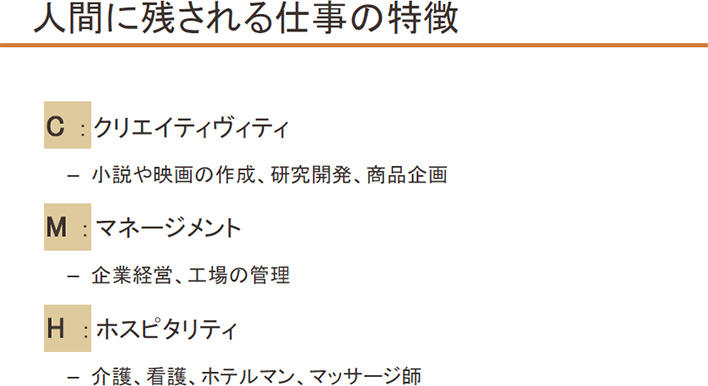
それでは、私たち人間はどうすれば良いのでしょうか。まずはオートメーション化をもっと進める必要があります。現在は第3次産業革命の真っ只中です。もっとIT化を進める必要があり、同時にAIの研究者だけでなく、「AIを活用できる文系の人材」を増やす必要があります。その上で、人間は人間にしかできないクリエイティブな仕事に特化することを、企業は意識していかなければならないと思っています。
理研AIPセンターが取り組む機械学習研究の最先端
理化学研究所 革新知能統合研究センター
センター長
杉山 将 氏
2016年度より文部科学省が「AIPプロジェクト」を開始しました。これはAI、ビッグデータ、IoT、サイバーセキュリティを含む統合プロジェクトで、このもとで理化学研究所は「革新知能統合研究(AIP)センター」を設立しました。AIPセンターは「次世代基盤技術の開発」「サイエンスを発達」「社会実装に貢献」「倫理・社会的課題への対応」「人材育成」の5つの事業を展開しています。
AIに関する研究開発は世界規模の競争ですが、主要な応用研究は既に予算規模の勝負になりつつあります。それに対し、基礎研究はまだまだ「個人勝負」の様相です。現在ブームになっているテーマを追いかけるのではなく、10年後に花咲くかもしれないテーマに賭けていくことが重要ではないかと思います。
昨今はディープラーニングが非常に注目されていますが、現状の技術では未だ解決できない問題もたくさんあります。今後もディープラーニングの基礎研究にしっかりと力を入れて、さらなるの性能・効率の向上につなげていきたいと考えています。
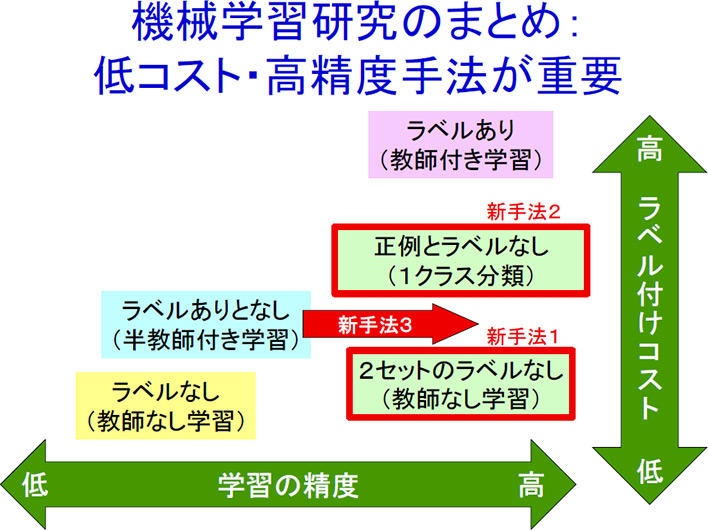
また、「ビッグデータ+ディープラーニング」が現在盛んに研究されていますが、分析に必要なデータのラベル付けのコストが高いのが実用上の問題となっています。そこで、私たちは、「正例とラベルなし例からの分類」など色々な方法を試しています。機械学習の研究としては、ラベル付のコストが低くて学習の精度が高い手法を作ることが今後ますます重要になっていくと考えています。
AI、スパコンが拓く医療・創薬の未来
京都大学大学院 医学研究科
教授
奥野 恭史 氏
私の研究室では精密医療や創薬の革新的な技術開発にフォーカスし、特にシミュレーション技術やAIを駆使した医療・創薬の高度化に取り組んでいます。精密医療では、人のゲノム情報が簡単に測定できるようになり、これを用いて個人の体質に基づいてより効果的で安全な治療の選択をするという研究が進んでいます。
例えば、ゲノム配列のコードがあればどんな病気になりやすいか、どんな薬が効きやすいかが分かります。個人ごとに分かれば精密な医療ができます。このような理由でゲノム医療=精密医療が世界中で進んでいますが、そういった課題を解決するというところで、AIが非常に注目をされています。
ゲノム医療におけるAIとしては、IBMのWatsonがあります。日本でも日本人のゲノムを使ってしっかりとAIを作ろうということで、京大と富士通で日本版Watsonを作るプロジェクトを開始しました。
Watsonというのはがん治療で有名ですが、私たちはがんに限らず様々なゲノムのAIを目指しており、「予測」も可能なAIを、次世代のAIとして開発したいと思っています。
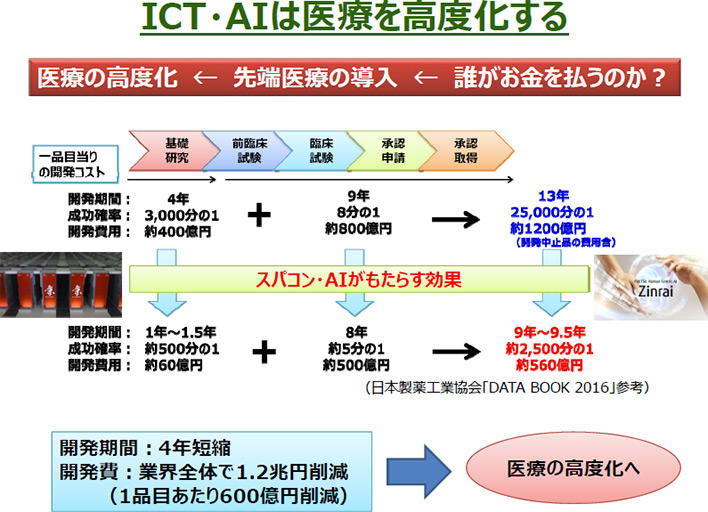
医薬品の開発において非常に問題なのが、開発のコストと時間です。開発の費用としては、だいたい1品目あたり1200億円位かかると言われています。また開発期間は10年以上かかると言われています。医療を高度化するには先進の医療が必要で、先進の医療を入れるためにはお金がかかります。こういう状況の中で私自身が目指しているのは、創薬にスーパーコンピュータとAIの技術を導入して、医薬品の開発コストを劇的に下げようということです。例えば開発期間で4年の短縮、あるいは業界全体で1.2兆円位の削減ができないかと考えています。
この時、スーパーコンピュータやAIの技術は非常に重要な武器になります。この意味で、日本のIT企業に大きな期待をしています。
AIによって、私たちの未来はどう変わるのか
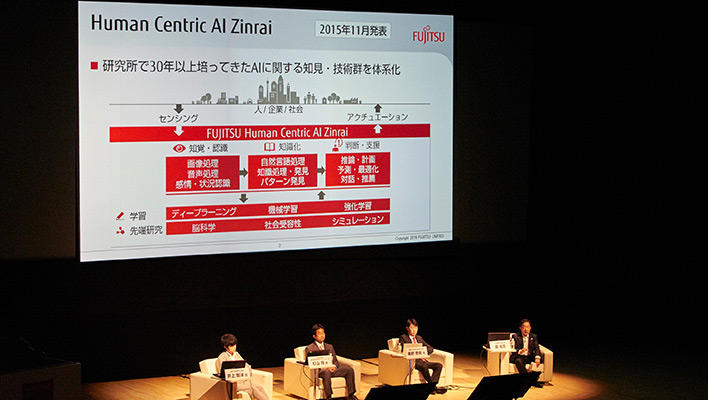
カンファレンスの後半は、先に登壇した3名の方々にモデレータを加え、「AIの現状と未来」について、社会、ビジネス、倫理の3つの観点からパネルディスカッションの形で進みました。
AIがもたらす社会とビジネス

<モデレータ>
富士通株式会社
執行役員
原 裕貴
モデレータの原裕貴は、「AIと社会」「AIとビジネス」「AIと倫理」という3つのテーマを設定。最初のテーマ「AIと社会」について、理化学研究所の杉山将氏は、特定のタスクに特化した「特化型AI」と人間のような知性を持った「汎用型AI」の間にはまだまだ大きな隔たりがあるとし、「現在、危惧されているような人間を駆逐するようなAIの出現を心配する必要はない」ことを説明しました。
京都大学の奥野恭史氏からは、医療分野におけるAIへの期待や関わりについて紹介がありました。奥野氏が専門とする医療分野は、日本が抱える社会問題そのもの。高齢化や医療費など、AIによって状況を好転させられるテーマが多くある一方、AIによる誤診などの心配も存在します。奥野氏は「AIが誤診をした時にどうするかという話がありますが、AIが出した回答で、すぐそのまま治療につなげることはありません」と説明。「医師がいるのですから、AIの補助を受けて医師が最終的な判断を下します。そういった所で厚労省とも話をしています」と、医療分野にAIが普及しても医師の存在が必要であることを強調しました。
また、たとえ専門外の医師であっても、AIを利用することで「ある程度の医学知識で安全な治療ができる」と、医療分野でAIに寄せる期待が大きいことを示しました。
駒沢大学の井上智洋氏からは、AIが普及することで労働者の分布傾向が変わり、クリエイティビティやマネージメントなどの頭脳労働に就く人がかなり増える可能性があることを紹介しました。
AIが普及すると、今の仕事はなくなる?
続く「AIとビジネス」に関するテーマでは、”AIによって仕事が失われるのか”を中心にディスカッションを展開しました。もし、AIによって今の仕事がなくなるのであれば、私たちはどうすれば良いのでしょうか。
これに対して井上氏は、「2045年くらいには全人口の1割くらいしか働いていない」というシナリオを公開。さらに、「現時点でもIT化によって仕事の内容や就労状況が変化していますが、ITのもっとインテリジェントなものをAIと考えた時に、これからますますAIの影響は高まっていくと考えられます」と、将来的な予測を示しました。
このような汎用型AIの登場について、杉山氏は「科学者の立場からは正確な年代は予測できませんが、近い将来ではないと思います。それまでにかなりのブレークスルーを続ける必要があるかもしれません」と意見を述べました。
また、「AIがすべての業種で人から仕事を奪うのか」という疑問については、奥野氏から「医療従事は人と人との触れ合いで、例えば患者は看護師がどう接したかによって癒やされ方が変わる。そういったことがAIにできるとは思えません」とし、さらに「医療の現場では、機械にできることはAIに任せるなど、人間の負担を減らす環境に期待したい」などの意見を述べました。
これに関して杉山氏は、「我々が研究している機械学習はAIの頭脳の部分ですが、AIのシステムが実際に社会に導入されて使われていく時には、人間と触れ合う部分の研究が大事になってきます」と説明。「AIの基礎技術が発展してかなり賢いものができたとすると、ある意味頭脳労働はなくなるかもしれませんが、本当に人間と触れ合う部分は最後まで残ると思っています」と、ホスピタリティのないAIの発展だけで社会や仕事の環境が激変することはないとの考えを示しました。
AIが発展すると、今までにない倫理が求められる
今後、AIが社会の中に浸透してくることは間違いがありません。しかし、その時に倫理の問題が問われることになります。例えば自動運転や医師の診療は、どこまでをAIに任せて良いのか。問題が起こった場合には誰が責任を取るのか。パネルディスカッションの最後には、「AIと倫理」についての意見交換を行いました。
医療に携わる奥野氏は、AIを利用する責任は”その人”にあるとの見解を示しました。「例えば医師が何か調べたいことがある時、今はGoogleで医師自身が情報を探しますが、そういう作業をAIが代わりに行うと、論文を読む時間のない医師は非常に助かるわけです。でもそれをどの辺で留めておくか、どう判断するかは最終的には医師の技量に関わってきます」
この他、杉山氏は、新入社員の採用選別にAIを利用するのは比較的簡単にできるが、人間が介さない選別で不具合があった場合の責任をどこに設定するか、といった懸案事項も紹介しました。
モデレータの原は、「AIは人間のための技術。普及と安全な運用に向けて解決すべき課題はまだまだ山積みの状態です。AIの導入は世界的な流れでもあり、その中で日本が遅れを取らないよう、制度の整備や投資の継続が必要です」と述べ、パネルディスカッションを締めくくりました。
“AI (artificial intelligence)” attracts attention in many fields. Due to the breakthrough of deep learning, it developed rapidly in the 2010s. AI realized by highly evolved computer processing power and software technology is expected to change our lives as well as the utilization of IoT and big data. How will AI, which has entered the era of full-scale diffusion, change our lives, industries, and society?
Current status and future trends of AI
In the first half of the conference, experts from various fields will be invited to discuss the three themes of “specialized AI” that can only handle specialized tasks, an overview of evolutionary AI, R & D efforts related to AI, and future medical care utilizing AI. I had a lecture.
Now humans are at the fork of whether AI can be used
Associate Professor, Faculty of Economics, Komazawa University
Tomohiro Inoue
Until now, AI is so-called “specialized AI”. Only specialized tasks such as chess for chess and shogi for shogi can be processed. However, even if it is specialized, AI will be used in a wide range of aspects of real space by 2020. This is because “smart machines (smart machines = autonomously moving machines)” such as self-driving cars, autonomous drones, and self-driving tractors will begin to spread. In 2025, AI that can understand languages will appear, and when it is installed in robots, customer service robots and butler robots will be used. And in 2030, it is thought that “general-purpose AI” will appear. This is an AI that can exercise intelligence in various situations like humans. Humans have general-purpose intelligence to handle various tasks, but in the future, AI that can handle such general-purpose processing will be born.
It is said that 2030 will bring about a dramatic change in the production structure, the “Fourth Industrial Revolution.” This means that machines carry out production activities on behalf of humans. There is a possibility that there will be a big difference in the economic growth rate after 2030 between countries that have introduced technologies such as general-purpose AI and have advanced production automation to a high degree, and those that have not. In other words, we are now at a fork. Whether companies or individuals can utilize AI, it is thought that disparities will open in various aspects.
So what should we humans do? First of all, we need to further automate. It is currently in the midst of the Third Industrial Revolution. It is necessary to promote more IT, and at the same time, it is necessary to increase not only AI researchers but also “human resources of humanities who can utilize AI”. On top of that, I think that companies must be aware that humans specialize in creative work that only humans can do.
The cutting edge of machine learning research undertaken by RIKEN AIP Center
RIKEN Center for Advanced Intelligence Research
manager of centre
Masashi Sugiyama
The Ministry of Education, Culture, Sports, Science and Technology started the “AIP Project” in 2016. This is an integrated project that includes AI, big data, IoT, and cybersecurity, under which RIKEN established the Innovative Intelligence Integrated Research (AIP) Center. The AIP Center develops five businesses: “development of next-generation basic technology,” “development of science,” “contribution to social implementation,” “response to ethical and social issues,” and “human resources development.”
R & D on AI is a global competition, but major applied research is already becoming a budget-scale competition. On the other hand, basic research is still in the aspect of “individual competition”. I think it’s important to bet on a theme that may bloom in 10 years, rather than chasing the theme that is currently booming.
Deep learning has received a lot of attention these days, but there are still many problems that cannot be solved by current technology. We will continue to focus on basic research on deep learning to further improve performance and efficiency.
In addition, “big data + deep learning” is currently being actively researched, but the high cost of labeling the data required for analysis is a practical problem. Therefore, we are trying various methods such as “classification from positive and unlabeled examples”. As for machine learning research, I think it will become more and more important in the future to create methods with low labeling costs and high learning accuracy.
The future of medical care and drug discovery pioneered by AI and supercomputers
Graduate School of Medicine, Kyoto University
Professor
Mr. Yasushi Okuno
In my laboratory, I focus on the development of innovative technologies for precision medicine and drug discovery, and in particular, I am working on the advancement of medical care and drug discovery by making full use of simulation technology and AI. Precision medicine has made it easier to measure human genomic information, and research is underway to use it to select more effective and safe treatments based on the individual’s constitution.
For example, if you have the code of the genome sequence, you can know what kind of disease you are likely to get and what kind of medicine is effective. Precise medical care can be provided if it is known for each individual. For this reason, genomic medicine = precision medicine is advancing all over the world, and AI is drawing a great deal of attention in solving such problems.
IBM’s Watson is an AI in genomic medicine. In Japan as well, we have started a project to make a Japanese version of Watson at Kyoto University and Fujitsu with the intention of making AI firmly using the Japanese genome.
Watson is famous for cancer treatment, but we are aiming for AI of various genomes not limited to cancer, and we would like to develop AI that can be “predicted” as the next generation AI. ..
A major problem in drug development is the cost and time of development. It is said that the development cost is about 120 billion yen per item. It is said that the development period will take more than 10 years. Advanced medical care is required to advance medical care, and it costs money to include advanced medical care. Under these circumstances, my goal is to introduce supercomputer and AI technologies into drug discovery to dramatically reduce drug development costs. For example, we are thinking about shortening the development period by 4 years, or reducing the industry as a whole by about 1.2 trillion yen.
At this time, supercomputer and AI technologies become very important weapons. In this sense, I have great expectations for Japanese IT companies.
How AI will change our future
In the latter half of the conference, moderators were added to the three people who took the stage earlier, and a panel discussion was held on “the current state and future of AI” from the three perspectives of society, business, and ethics.
Society and business brought about by AI
<Moderator>
Fujitsu Limited
Operating officer
Yuki Hara
Moderator Hiroki Hara has set three themes: “AI and society,” “AI and business,” and “AI and ethics.” Regarding the first theme, “AI and society,” Masashi Sugiyama of RIKEN said that between “specialized AI” that specializes in specific tasks and “general-purpose AI” that has human-like intelligence. He explained that there is still a big gap, and “you don’t have to worry about the emergence of AI that will drive out humans who are currently worried.”
Mr. Yasushi Okuno of Kyoto University introduced his expectations and involvement in AI in the medical field. Mr. Okuno specializes in the medical field, which is the social problem that Japan faces. While there are many themes such as aging and medical expenses that can be improved by AI, there are also concerns about misdiagnosis by AI. Mr. Okuno explained, “There is talk about what to do when AI makes a misdiagnosis, but the answer given by AI will not immediately lead to treatment.” “Since we have doctors, they make the final decision with the assistance of AI. We are talking with the Ministry of Health, Labor and Welfare at that point,” he said, even if AI spreads in the medical field. He emphasized the need for existence.
He also showed that even non-specialized doctors have high expectations for AI in the medical field, saying that using AI “can provide safe treatment with a certain amount of medical knowledge.”
Mr. Tomohiro Inoue of Komazawa University introduced that the spread of AI will change the distribution tendency of workers, and there is a possibility that the number of people who will be engaged in brain labor such as creativity and management will increase considerably.
Will my current job disappear when AI becomes widespread?
In the following theme on “AI and business,” the discussion centered on “Will AI lose work?” What should we do if AI eliminates our current job?
Inoue, on the other hand, released a scenario that “only about 10% of the total population will be working by 2045.” Furthermore, “At present, the content of work and the working situation are changing due to the introduction of IT, but when we think of more intelligent IT as AI, the influence of AI is expected to increase in the future.” , Showed future forecasts.
Regarding the emergence of such general-purpose AI, Mr. Sugiyama said, “From a scientist’s point of view, the exact age cannot be predicted, but I think it is not in the near future. It may be necessary to continue a considerable breakthrough by then. No, “he said.
Regarding the question, “Does AI rob people of jobs in all industries?”, Mr. Okuno said, “Medical care is a person-to-person contact, for example, patients are healed by how nurses interact with each other.” I don’t think AI can do that, “he said.” In the medical field, I’d like to expect an environment that reduces the burden on humans, such as leaving what machines can do to AI. ” rice field.
Regarding this, Mr. Sugiyama said, “Machine learning that we are studying is a part of the brain of AI, but when the AI system is actually introduced into society and used, it is important to study the part that comes into contact with humans. It will be. ” “If the basic technology of AI develops and something quite smart is made, in a sense, brain labor may disappear, but I think that the part that really touches humans will remain until the end,” said AI without hospitality. He expressed the idea that development alone would not drastically change the social and work environment.
As AI develops, unprecedented ethics will be required
There is no doubt that AI will permeate society in the future. However, at that time, ethical issues will be asked. For example, how much can AI handle autonomous driving and medical treatment by doctors? Who will take responsibility in case of problems? At the end of the panel discussion, we exchanged opinions on “AI and ethics.”
Mr. Okuno, who is involved in medical treatment, said that the responsibility for using AI lies with “the person”. “For example, when a doctor wants to find out something, the doctor himself searches for information on Google now, but if AI does that work instead, it will be very helpful for doctors who do not have time to read the dissertation. But where to keep it and how to decide it ultimately depends on the skill of the doctor. ”
In addition, Mr. Sugiyama also introduced issues such as where to set responsibility in case of problems in selection without human intervention, although it is relatively easy to use AI for recruitment selection of new employees. Did.
The moderator Hara said, “AI is a technology for humans. There are still a lot of problems to be solved for dissemination and safe operation. The introduction of AI is also a global trend, and Japan is behind in that. It is necessary to improve the system and continue investment so as not to take it, “said the panel discussion.


