

視床下部の役割は? 自律神経系、内分泌系を調節する「本能の総合職」
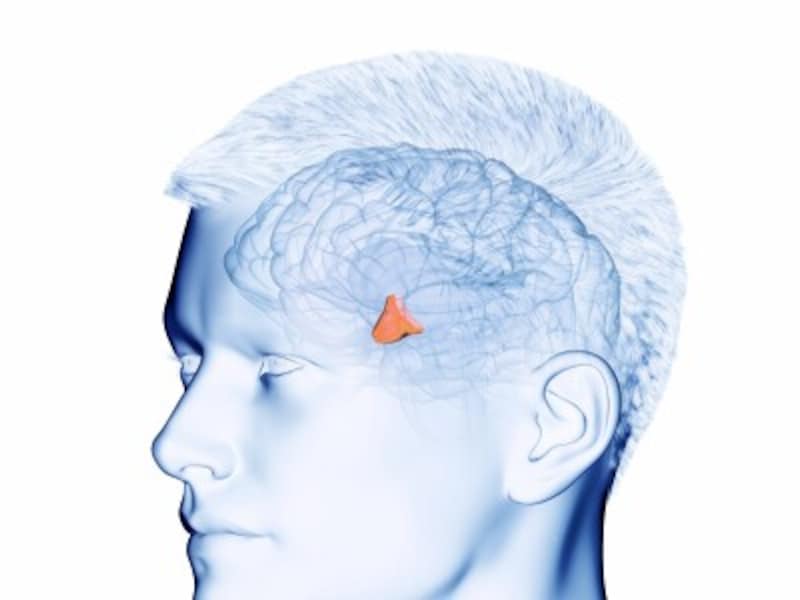
間脳にある視床下部。自律神経系や内分泌系を調整する、いわば「本能の総合職」です
視床下部は、脳の中心あたりにある間脳に属し、自律神経系や内分泌系を調節することで、生きていくために必要な本能の中枢として機能しています。
脳幹のうち、脊髄から中脳までの下位の部分が、呼吸運動、心臓血管運動、嘔吐、咳、嚥下など、個別の機能だけを専門的に担当しているのに対して、視床下部は、全身に張り巡らされた自律神経系や内分泌系をコントロールすることによって、生命維持に必要な体の働きを全体として総合的に調節しています。
具体的な役割としては、本能的欲求である食欲、睡眠、性欲をコントロールしたり、体温の調節、体内水分量の調節、体内時計の調節、血圧や消化機能の調節なども担当しています。このうち、今回は、視床下部による体温調節の仕組みを解説します。
人間の体温を一定に保つ「ホメオスタシス」……哺乳類が生き延びた要因の一つ
多くの哺乳動物と同じように、私たち人間の体温は、暑いところでも寒いところでも、いつもだいたい同じに保たれていますが、どうしてそうなっているのでしょうか。
体の中で、食べ物を消化するために働く消化酵素や、不要物を分解するために働く代謝酵素などは、ある決まった温度で機能しますから、もし外気に応じて体温が上がったり下がったりすると、酵素の働きも変わってしまいます。酵素以外にも、機能が温度に依存している仕組みはたくさんあります。そうした体の働きを変えないためには、体の内部環境をできるだけ一定の状態に保つことが必要です。そして、実際に私たち人間の体にはそういう仕組みが備わっています。それが「ホメオスタシス(恒常性)」です。体温調節は、ホメオスタシスの一つなのです。
また、外気温が変化しても体内温度を一定に保つことができるようになったことで、私たちは、行動範囲を広げることができるようになりました。例えば、すごく寒い日に外に出かけて、体温が下がってしまい体の機能がストップしてしまったらたいへんですね。逆に猛暑日でもたいへんなことになりますね。暑くても寒くても、服装を少し変えるだけで、遠方へ旅行できるのは、体の内部環境を一定に保つ仕組みを獲得できたからに他なりません。
恐竜は、約2億3000万年前に誕生し長い間地球を支配していたのに、約6,600年前に絶滅してしまいました。隕石衝突の影響で気温が著しく下がったことが主要因だと言われています。地球上のおよそ75%の命が奪われたとされる時代を、哺乳類が生き延びられたのは、体温調節の仕組みを持っていたからだと思われます。
体温調節の仕組みを応用して作られたサーモスタットやエアコン
サーモスタット(thermostat)という装置をご存知でしょうか。thermoは「温度」、statは「制御」「一定に保つ」と言う意味です。理科の実験などで、温度を一定に保つために使う装置で、「自動温度調節器」とも訳されます。多くの場合、お湯をわかすためのヒーターと、2種類の金属が組み合わされたセンサーが組み込まれており、浴槽に溜めた水につけて使われます。水温が設定温度より低いときには、ヒーターがONになって加熱が行われ、水温が設定温度を超えるとヒーターを切って冷ます、ということを繰り返すことで、水温が設定温度に保たれるのです。同じような仕組みは、湯沸かし器やオーブン、エアコンなどにも使われています。
私たちの体に備わっている体温調節の仕組みも同じです。と言うか、実際は逆とも言えます。体温調節の仕組みを研究した結果、その原理を応用して作られたのが、サーモスタットやエアコンなのです。
視床下部の視索前野にある体温調節中枢
私たちの体温をコントロールする制御部は、体温調節中枢と呼ばれ、下図に示したように、視床下部の前の方にある「視索前野」という場所にあります。
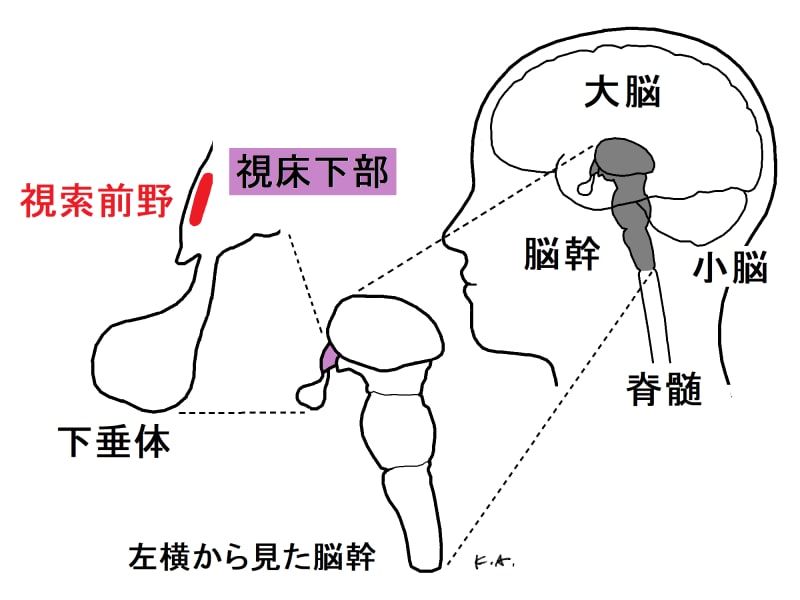
体温調節中枢は、視床下部の視索前野にあります(ガイドが作成したオリジナル図)。
ここで、体温はだいたい36~37℃になるように設定されています。一方、温度センサーは、皮膚の下、脊髄、脳の中などにあります。皮膚の下にあるセンサーは、外気にさらされた皮膚の温度を測り、外気温の変化を敏感に察知します。脊髄や脳の中にあるセンサーは、体の内部の温度を測り、体内で発生する熱を敏感に察知します。センサーとは言っても金属でできた装置があるわけではありません。知覚神経の先端に、一定範囲の温度に反応する複数の特別なタンパク質(温度受容器と呼ばれる)があって、それらの応答によって、暑い冷たいが判別されているのです。
温度センサーとしての役割を果たす知覚神経の末端で捉えられた情報は、神経線維を通して、脳の視床下部の体温調節中枢に伝えられ、体温が設定温度(36~37℃)より高いか低いかが判断されます。皮膚あるいは体の内部が高いと判断されると、体温調節中枢は、体温を下げようとして、体に必要な反応を引き起こす指令を出します。例えば、自律神経系を調節して皮膚の血管を拡張させて、体表面にたくさんの血液を流し、体にたまっている熱を体表面から外気へ逃がそうとします。また、皮膚の汗腺を刺激してたくさんの汗を出し、汗の蒸発によって体表面から熱を失わせようとします。外気が暑いまたは体の中が熱いと感じると、顔が赤くなったり、汗がでてくるのは、このためです。
皮膚あるいは体の内部が設定温度より低いと判断された場合、体温調節中枢は、体温を上げようとして、体に必要な反応を引き起こす指令を出します。例えば、自律神経系を介して皮膚の血管を収縮させ、体から外気へ熱が逃げないように防ぎます。内分泌系の甲状腺や副腎皮質からのホルモン分泌を促して、内臓や骨格筋の代謝による熱産生を促進します。また、体性神経系を介して手足の筋肉を小刻みに動かして熱を産生して体を温めようとします。外気が寒いまたは体の中が冷たいと感じると、皮膚が白くなったり手足がブルブルと震えるのは、このためです。
まとめると、私たちの体に備わった体温調節は、視床下部の視索前野にある神経細胞が、血管の収縮・拡張や発汗を引き起こす自律神経系、代謝による熱産生を生じる内分泌系、骨格筋を動かす体性神経系を総合的に動かすことによって成り立っているのです。これがすべて、生まれつき備わっていて、無意識のうちに間違いなく行われているとは、驚きですね。
視床、視床下部、松果体、脳下垂体
間脳は視床、視床下部、松果体、脳下垂体から構成されています(図1)。
- 視床:全身の感覚、視覚、聴覚などの情報を認識し、大脳皮質、大脳基底核に伝達しています。
- 視床下部:自律神経系の中枢です。体温調節、血圧、心拍数、摂食行動や飲水行動、性行動、睡眠など本能行動および怒りや不安などの情動行動を調節します。内分泌ホルモン系の中枢も担っており、尿量の調節、子宮収縮、乳汁分泌なども司っています。
- 松果体:概日リズムを調節するホルモンや、メラトニンを分泌しています。
- 脳下垂体:ホルモンを分泌する本管で、前葉と後葉に分かれ、それぞれから異なるホルモンが分泌されます。
What is the role of the hypothalamus? “Instinctual generalist” who regulates the autonomic nervous system and the endocrine system
hypothalamus in the diencephalon. Adjusting the autonomic nervous system and endocrine system, so to speak, it is an “instinct careerist”
The hypothalamus belongs to the diencephalon, which is located in the center of the brain. By regulating the autonomic nervous system and the endocrine system, the hypothalamus functions as the center of instincts necessary for life.
While the lower parts of the brainstem, from the spinal cord to the midbrain, are specialized in individual functions such as respiratory movements, cardiovascular movements, vomiting, coughing, and swallowing, the hypothalamus By controlling the autonomic nervous system and the endocrine system, which extend throughout the body, the body’s functions necessary for life support are regulated comprehensively.
As specific roles, it controls instinctive desires such as appetite, sleep, and libido, regulates body temperature, regulates the amount of water in the body, regulates the internal clock, and regulates blood pressure and digestive functions. Of these, this time, we will explain the mechanism of temperature regulation by the hypothalamus.
“Homeostasis” that keeps human body temperature constant … One of the factors that mammals survived
Like most mammals, our body temperature stays roughly the same whether it’s hot or cold, but why is that?
In the body, digestive enzymes that work to digest food and metabolic enzymes that work to break down unnecessary substances function at a certain temperature. , the function of the enzyme is also changed. In addition to enzymes, there are many other mechanisms whose function is dependent on temperature. In order not to change the function of the body, it is necessary to keep the internal environment of the body as constant as possible. And in fact, our human body has such a mechanism. That is “homeostasis”. Thermoregulation is part of homeostasis.
In addition, even if the outside temperature changes, we can now maintain a constant internal temperature, which allows us to expand our range of activities. For example, if you go outside on a very cold day and your body temperature drops and your body functions stop, that would be a big problem. On the contrary, it will be a big problem even on a hot day. Whether it’s hot or cold, you can travel long distances just by changing your clothes a little.
Dinosaurs were born about 230 million years ago and dominated the earth for a long time, but they became extinct about 6,600 years ago. It is said that the main reason is that the temperature dropped significantly due to the impact of the meteorite impact. It is thought that mammals were able to survive an era in which approximately 75% of life on earth was lost because they had a mechanism for regulating body temperature.
Thermostats and air conditioners made by applying the mechanism of temperature regulation
Have you ever heard of a device called a thermostat? thermo means “temperature” and stat means “control” or “keep constant”. A device used to maintain a constant temperature in science experiments, etc., and is also translated as an “automatic temperature controller.” In many cases, it has a built-in heater that heats the water and a sensor that combines two types of metals, and is used by dipping the water in the bathtub. When the water temperature is lower than the set temperature, the heater is turned on and heating is performed, and when the water temperature exceeds the set temperature, the heater is turned off to cool down. By repeating this process, the water temperature is kept at the set temperature. . Similar mechanisms are used in water heaters, ovens, and air conditioners.
The same is true for our body’s thermoregulatory mechanism. Or, in fact, the opposite can be said. Thermostats and air conditioners were created by applying this principle as a result of research into the mechanism of body temperature regulation.
thermoregulatory center in the preoptic area of the hypothalamus
The control unit that controls our body temperature is called the thermoregulatory center, and as shown in the diagram below, it is located in a place called the “preoptic area” in front of the hypothalamus.
The thermoregulatory center is located in the preoptic area of the hypothalamus (original drawing made by Guide).
Here, the body temperature is set to be approximately 36-37°C. Temperature sensors, on the other hand, are located under the skin, in the spinal cord, in the brain, and so on. A sensor under the skin measures the temperature of the skin exposed to the outside air and sensitively senses changes in the outside temperature. Sensors in the spinal cord and brain measure the temperature inside the body and are sensitive to the heat generated inside the body. There is no device made of metal even though it is called a sensor. At the tips of sensory nerves, there are multiple special proteins (called thermoreceptors) that respond to a certain range of temperatures, and their responses determine hot or cold.
Information captured by the terminals of sensory nerves, which act as temperature sensors, is transmitted through nerve fibers to the thermoregulatory center in the hypothalamus of the brain to determine whether the body temperature is higher or lower than the set temperature (36-37°C). will be When the skin or interior of the body is judged to be hot, the thermoregulatory center issues commands that cause the body to respond in an attempt to lower the body temperature. For example, it regulates the autonomic nervous system to dilate blood vessels in the skin, allowing more blood to flow to the surface of the body and allowing heat accumulated in the body to escape from the surface of the body to the outside air. It also stimulates the sweat glands in the skin to produce a lot of sweat, and the sweat evaporates to lose heat from the surface of the body. This is why your face turns red and you start sweating when you feel hot outside or inside.
When the skin or interior of the body is judged to be cooler than the set temperature, the thermoregulatory center issues commands that cause the body to react in an attempt to raise the body temperature. For example, it constricts blood vessels in the skin via the autonomic nervous system to prevent heat from escaping from the body to the outside air. This medicine promotes hormone secretion from the thyroid gland and adrenal cortex of the endocrine system, and promotes thermogenesis through metabolism in internal organs and skeletal muscles. It also tries to warm the body by producing heat by wiggling the muscles of the hands and feet via the somatic nervous system. This is why your skin turns white and your hands and feet tremble when you feel cold outside or inside your body.
To summarize, the body’s thermoregulatory system consists of nerve cells in the preoptic area of the hypothalamus that cause the contraction and dilation of blood vessels and perspiration, the autonomic nervous system, the endocrine system that produces metabolic heat, and skeletal muscles. It consists of comprehensively moving the somatic nervous system that moves the It’s amazing that all this is innate and unconsciously done without fail.
thalamus, hypothalamus, pineal gland, pituitary gland
The diencephalon is composed of the thalamus, hypothalamus, pineal gland, and pituitary gland (Fig. 1).
Thalamus: It recognizes sensory, visual, and auditory information from the whole body and transmits it to the cerebral cortex and basal ganglia.
Hypothalamus: The center of the autonomic nervous system. It regulates instinctive behaviors such as thermoregulation, blood pressure, heart rate, eating and drinking behaviors, sexual behaviors, sleep, and emotional behaviors such as anger and anxiety. It also plays a central role in the endocrine hormone system, controlling urine output, uterine contraction, and milk secretion.
Pineal gland: secretes hormones that regulate circadian rhythms and melatonin.
Pituitary gland: The main hormone-secreting tube, divided into anterior and posterior lobes, each of which secretes different hormones.


